Direct Vision Standard 2024 – Is your fleet compliant?
HGVs over 12 tonnes operating in Greater London that do not meet the required three-star rating will need to install a Progressive Safe System by 28 October 2024 or be proven to have an installion scheduled by the extended grace period (expiry 4th May 2025) to comply with the updated Direct Vision Standard. Failure to comply will result in a penalty charge of up to £550 per vehicle per day.
Direct Vision Standard (DVS)
DVS measures how much an HGV driver can see directly through cab windows. This indicates the level of risk to vulnerable road users (VRUs) i.e. pedestrians and cyclists.
PSS Requirements
1. Moving Off Information System (MOIS)
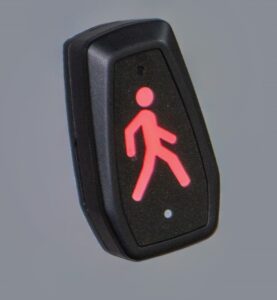
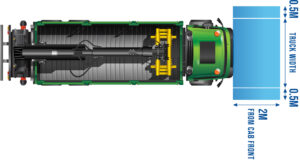
Direct Vision Standard 2024 requires all vehicles to have a front sensor system that detects pedestrians or cyclists entering the blind spot area in front of the vehicle. Detection systems must not be activated by street furniture, or parked vehicles, must recognise vulnerable road users, and must activate to a range of 2m along the front of the vehicle. The requirements of error notifications and when to issue an information signal versus a warning signal when at rest and manoeuvring are specifically defined.
2. Blind Spot Information System (BSIS)
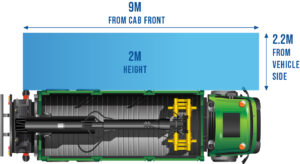
All vehicles must have a blind spot information system. The systems should only provide the information signal to the driver in response to the presence of a vulnerable road user (VRU) and not a car or a piece of roadside furniture (unless a collision with those items was imminent). The detection range must be 2m in height, 2.2m to the side, and 9m to the back. The system must be active at all vehicle speeds between 0 km/h and 30 km/h and able to issue information signals and warnings irrespective of the activation status of the direction indicators.
3. Camera Monitoring System
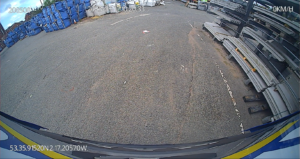
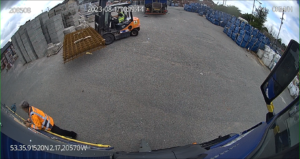
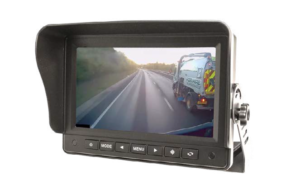
Camera systems fitted on vehicles must eliminate any remaining blind spots. This provides a visual alert of an approaching vulnerable road user and prevents collisions in the blind spot area.
4. Audio Warnings
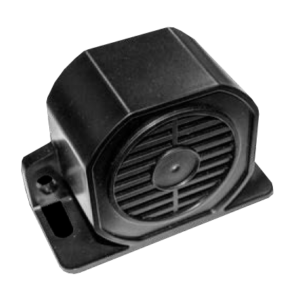
Audio warnings must be fitted to all vehicles, including those with left-hand drive to ensure all vehicles have the ability to warn VRU of an intended manoeuvre.
5. Warning Signage
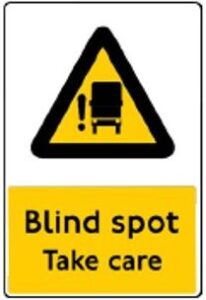
Warning signage requirements remain unchanged.
MOTORMAX DIRECT VISION STANDARD SOLUTIONS
REGULATION 151 & 159 PRODUCTS
Motormax offers products meeting UNECE 151 & 159 regulations guaranteeing 100% compliance for fleet operators.
Direct Vision Standard 2024 Upgrade Kit – (MM-DVS-24-U)
| Part Number | Description |
| MMPSS | BSIS & MOIS |
| MM7091AHD | 7″ Triple Input AHD Monitor |
Direct Vision Standard 2024 Full Kit (MM-DVS-24)
| Part Number | Description |
| MMPSS | BSIS & MOIS |
| MMLTA | Left Turn Alarm |
| MM7091AHD | 7″ Triple Input AHD Monitor |
| MMCAMSCAN | Can Unit |
| MM4PINDIN5M | 5m Cable |
Read more from Transport for London.